By 1870, the village along the tracks of the North Pennsylvania Railroad, in the eastern corner of Franconia Township, was thriving. A post office and railroad station had been established, both known as Souder’s. A building boom following the Civil War created the need for early industries, including a lumberyard, sawmill, two planing mills, a spoke and wheel factory, and door and sash manufactory. Not to mention five carpenters, two cabinet makers, and stone masons.
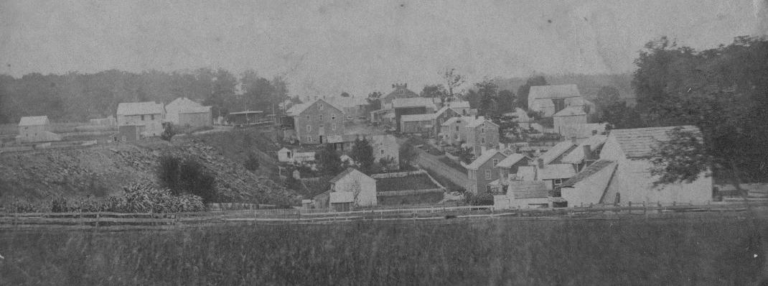
The earliest photo of Main St. Souderton dated 1868, looking south.
Along with a post office and train station there was a school, hotel, coal yard, hardware store, watch and repair shop, shoe makers, a cigar factory, two general stores, two feed mills, and four women who were sewing at home for tailors.
Close by were long-established churches, all of which were a strong influence in the community. By 1875 there were roughly 65 houses, one turnpike, four tiny roads, and several private lanes. But a village such as this is never formed for, nor sustained by, the residents alone. The farmers were the reason all this — railroad, industry, retail — was created. Farming families “came to town” to buy, sell, barter, swap news and enjoy the company of friends.
The people of Souder’s had just about everything they needed, except for a bank. Securing loans and making deposits was crucial for locals and farmers alike. And opening one was an idea everyone supported. It was relatively easy to open a banking institution following the Civil War — if you had sufficient capital. The National Banking Acts of 1863 and 1864 created federally
chartered banks that established standards and stability, all the while gaining peoples’ trust.
The first order of business in 1875 was to ponder a name. “Farmers,” “Franconia” and “Montconia National Bank” made the list. In 1876 the post office, railroad station, and village
name had been officially adopted as Souderton. So possibly influenced by the not-too-distant Civil War, “Union National Bank of Souderton” was chosen for the new institution, which then became
the eighth “national bank” in Montgomery County.
It appears that choosing a location for the bank building became a more contentious issue than choosing the name. Today we don’t give a lot of thought to trains when driving over the tracks at a railroad crossing. But in 1876 this was extremely difficult, indeed. The loud, steam-belching trains and screeching whistles, not to mention a physically rough crossing, made this an almost impossible task when dealing with a skittish horse.
The farmers who traveled from the Allentown Road to Main Street were in favor of a location on that side of the track. The farmers and land owners coming from Bethlehem Pike down County Line Road and what is today East Chestnut Street were in favor of building on that side. When the Main Street location was chosen, half the subscribers pulled out in a huff. But there were still enough backers, and the application was accepted. Souderton was able to establish a bank!
The first, temporary location was a safe in a tenant house on Main Street owned by the namesake of the village, Henry O. Souder, while a permanent banking house was built. Choosing Telford’s Isaac G. Gerhart as the first bank president apparently was a no-brainer. From 1863–1913, national banks were allowed to issue their own bank notes — as shown by this $5 bank note, recently acquired by Univest and signed by Gerhart.
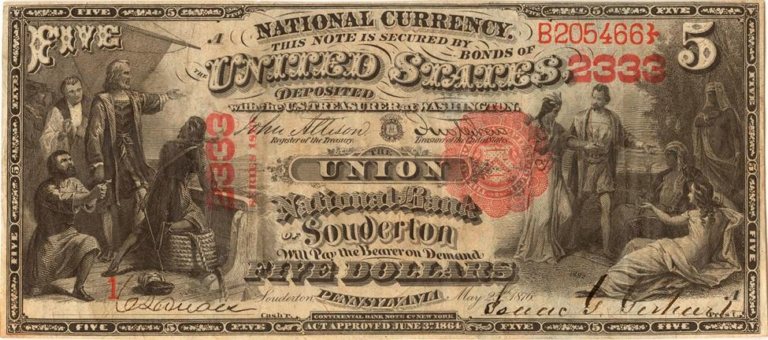
In May 1876, Union National Bank of Souderton issued its own $5 bank note.
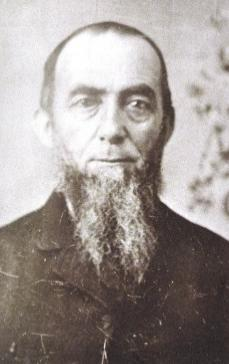
Isaac G. Gerhart,
the bank’s first
president, signed in the lower right corner of the note.
The building at 24 N. Main St. opened in 1877, and the locals who were involved in the building project had much to be proud of. A room at the back was set up with a settee, creating the perfect gathering place for men to discuss the affairs of the day. Having been built on one of the highest, centrally located positions in town, a bell was mounted in the attic with a rope pull located behind the teller cages for times of trouble.
Union National Bank flourished over the years. Capital stock increased in 1904 from $90,000 to $100,000 and was selling at high prices. A Savings Fund Department was formed in 1908.
The building was enlarged and modernized in 1909, the number of directors increased from eight to a maximum of 12 in 1917, and building alterations in 1922 included a 10-ton burglar-proof safe that was hoisted up to the new addition on the second floor.
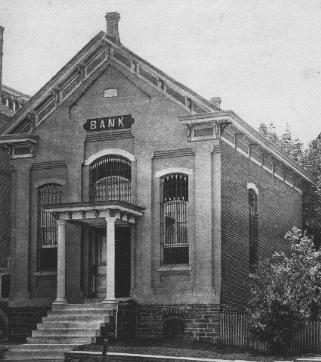
Through the years, from
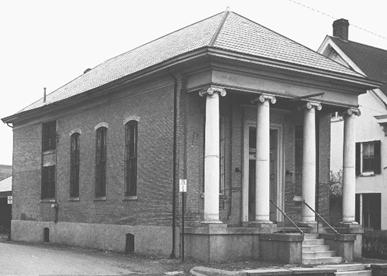
left: 1877 at 24 N. Main St;
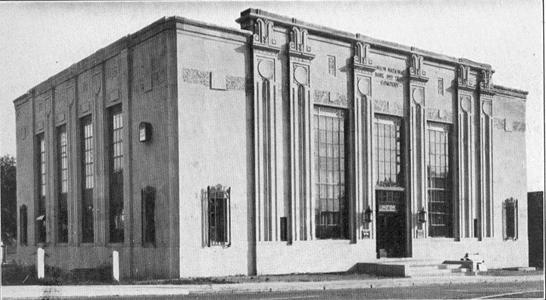
modified 1909 building; West Broad St., 1929.
The 1920s saw some of the most notable changes. The number of directors increased from 10 to a maximum of 20, banking by mail was instituted, and in 1928 the name was officially changed to Union National Bank and Trust Company of Souderton. By this time the bank had clearly outgrown its Main Street location, so plans were underway for a brand-new building to be erected, with locals once again providing part of the labor and material.
In 1929, the last of the original stock holders, John G. Barndt, passed away. Two months before the crash of the stock market in October — which closed more than one third of the national banks — the new bank building opened on West Broad Street with much fanfare. Two thousand people inspected the building on opening day, and a special supplement was printed in the Souderton Independent newspaper. The supplement gave the history of the institution and contained numerous, obviously proud, congratulatory ads. Here are a few examples.
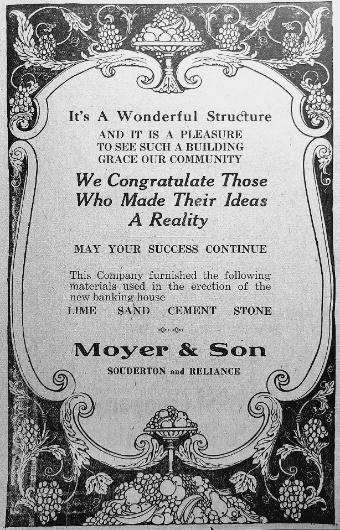
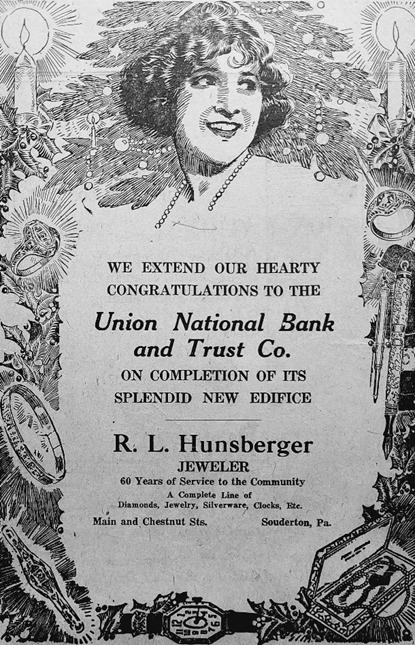
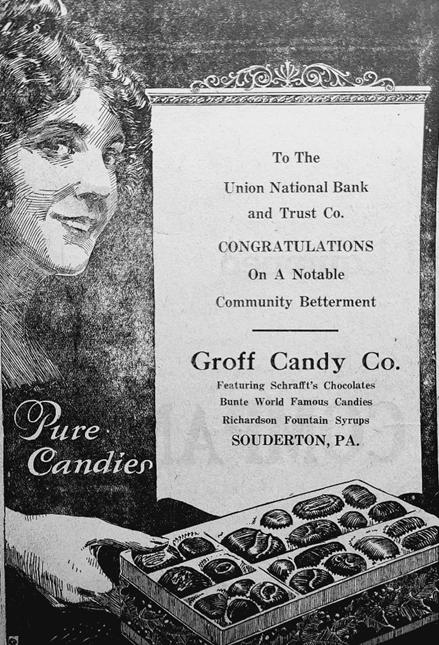
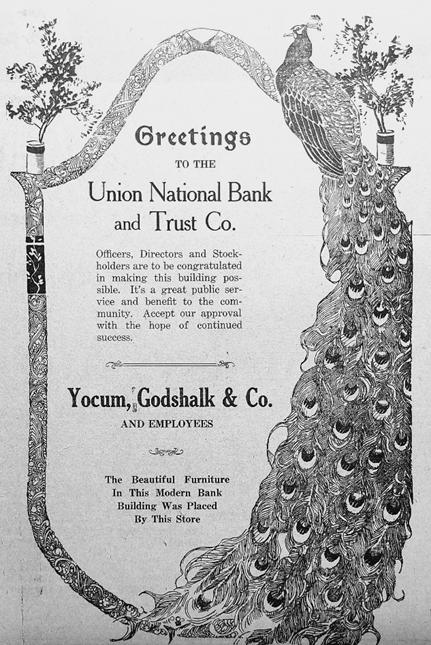
The 1954 merger with Telford National Bank kicked off the first of many in-town banks combining forces with Union National. New brick and mortar buildings were erected further from the towns, creating more convenient drive-up locations for the banking customers, where friendly tellers replaced the “hang-out” the older building had once provided.
Union National Bank was formed in Souderton and would stay in Souderton even as the town was changing. 1978 saw the end of a significant retail presence with the closure of the large department stores of Yocum & Godshalk and Renreg Hardware, built in 1893.
How the bank came to purchase the building being vacated by their closure is an example of how seriously Union National took its role as the borough’s home-grown bank. Former president Merrill Moyer remembers a Wednesday morning when Clarence Carbaugh came to his desk asking, “ ‘Did you hear, Yocum and Gottshalk is closing?’ Pretty stunning news for a small community like Souderton. I suggested Clarence tell Mr. Hoeflich, which he did. Within a few minutes he tracked out of the bank heading for Y&G, to see Harold Yocum. When he returned, which wasn’t very long, he and Harold had an agreement for UNB to acquire their half of the building. No price, just a hand shake.”
When the renovation was complete, Union National’s large bank headquarters was now located smack dab next to the original 1877 building. The name was changed to Univest National Bank and Trust Company in 2003. And in 2011, the now Univest Bank and Trust Company started doing business under a state charter regulated by the Federal Deposit Insurance Corporation (FDIC). These changes better aligned the bank with local regulation and markets.
The Univest of 2026 will tell you that the values on which Union National was founded have remained: rooted in tradition and standing for integrity, excellence, and faith. A Bible holds a prominent place in the board room. The eagle and shield on its logo, adopted in 2016, is a reference to Isaiah 40:31 from the Old Testament:
 “But they that wait upon the LORD shall renew their strength; they shall mount up with wings as eagles; they shall run, and not be weary; and they shall walk, and not faint.”
Univest remains committed to this community even as it has moved into other markets. It’s not just banking but also philanthropy. In 2025, employees clocked 15,000 volunteer hours and the corporation contributed $2.2 million to non-profits. This included a donation to the Souderton-Telford Historical Society that supported our 2026 project to install historical markers on 10 buildings that tell the story of Souderton. Two of those markers are mounted on Univest buildings. When the historical society realized that 2023 was the centennial of Souderton’s first Christmas tree lighting, Univest hosted a community celebration on its grounds and created refrigerator magnets to mark the occasion.
For 150 years, Univest has sought to build relationships, not just transactions, as a trusted advisor to the communities it serves. Join us in congratulating Univest Bank and Trust Company on its 150th anniversary in 2026!
Sources: Souderton Independent Newspapers 1881–1940; John L. Ruth, The History of the Indian Valley & its Bank, written for the centennial of the Union National Bank and Trust Company; John Landes, Univest Bank and Trust Co.
Learn more about the 2023 centennial of the first Christmas tree lighting.
***
The Souderton-Telford Historical Society seeks to preserve and share the history of our towns, businesses, and residents. Follow us on Facebook (@SoudertonTelfordHistory) and enjoy posts about local history. Do you have old photographs we can scan for our collection? Or a story to share about growing up in the Souderton-Telford area? We would like to hear from you! Email to newsletter@soudertontelfordhistory.org.
The Souderton-Telford Historical Society is a 501(c)(3) non-profit. Your contribution helps to collect, preserve, and share the history of our towns. Use the DONATE button on our Facebook page.
Or mail tax-deductible donations to:
Souderton-Telford Historical Society
127 E. Broad St.
Souderton PA 18964
***
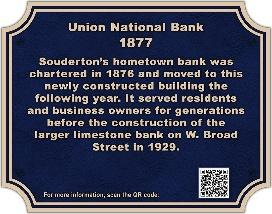 The original Union National Bank is one of the buildings now displaying a historical marker installed by the Souderton-Telford Historical Society. Read more about the 10 buildings that help tell the story of Souderton in our recent newsletter.
Our website also contains our newsletter archive tagged and filed for easy reading. We thank pixelMIGHT for donating its services.
 Search #Univest150 on YouTube to view videos produced for the 150th anniversary.
