Veterans’ service continues at home,
thanks to American Legion, VFW posts
with research by Cory Alderfer
The work of winding down World War II was well under way when the Souderton Independent reported on Dec. 6, 1945, that Cpl. Nicholas Rohs had arrived at his father’s home in Hilltown Township to begin rest furlough. He had been captured at Corregidor in the Philippines in 1942 and spent three years, 11 months, and four days as a prisoner of the Japanese. Rohs, the newspaper reported, was “well on his way” to full recovery.
For World War II veterans — and generations before and since — a return to civilian life was just the beginning. Many would look for comradeship and advocacy in organizations that had been founded for those purposes. Fortunately, veterans here could turn to two such groups:
- In Souderton, American Legion Post 234 had been present since 1919, chartered in the shadow of what was then called the Great War.
- In neighboring Telford, Veterans of Foreign Wars Post 5308 was chartered on Dec. 23, 1945, as reported in the Independent.
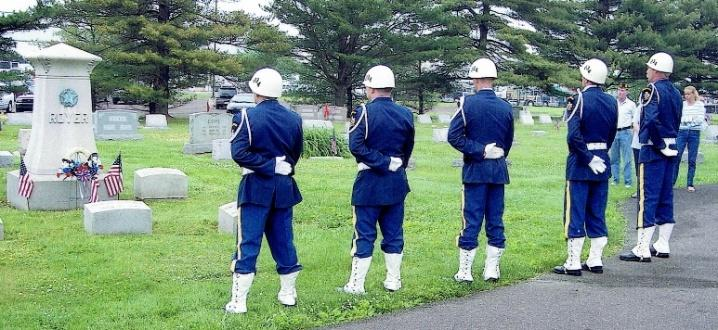
An American Legion Post 234 honor guard at
the grave of Warren Royer for Memorial Day.
Between these two organizations, local veterans have been served for more than a century. But as fewer Americans have a direct connection to the military, the work of these organizations is not well-known in our communities. Last year, the historical society profiled Warren Royer, the namesake of the American Legion post. Now we have researched and interviewed members of both organizations to better understand their history and role in the community.
The idea that veterans should band together in their own interest is not new. The country has a mixed record when it comes to veterans. It was only in 1818 — 35 years after the end of the Revolutionary War — that the nation wrote veterans’ pension legislation into law. Until then, those veterans never did receive promised payment or land for their service. Over the next few years, further legislation expanded pension programs for veterans generally and their widows.
Surely, veterans had gathered in fraternal ways all along. But the Grand Army of the Republic, an organization that served Union veterans after the Civil War, established a model that combined camaraderie with action on behalf of its members.
This was the model followed by the Veterans of Foreign Wars (VFW), established in 1899 after the Spanish-American War. Veterans who had returned from battlefields in Cuba and the Philippines formed local clubs across the country, which developed over the next few decades into the national organization we see today represented in Telford.
About 281,000 American sailors, Marines, and soldiers volunteered to serve in the four months of the Spanish-American War. Two decades later, almost 5 million served in World War I. And even as Souderton was holding a “welcome home” parade in August 1919 for its local veterans, a post of the new American Legion was being organized in town.
As State Organizer Stanley H. Hunsicker explained to the veterans at the parade, “The American Legion is the spontaneous outgrowth of a desire of the men who served in the late War to bind themselves together into an organization whose first principle is that of mutual helpfulness and assist in the kind of legislation that will benefit, and protect the rights of the men who fought so bravely and earnestly in upholding the traditions of democracy.”
The Legion already had presented a program of legislation to Congress which, if passed, Hunsicker said, would bring “many advantages … to the benefit of the men.”
Membership was open to all men who saw service from April 6, 1917, until Nov. 11, 1918, providing they performed their full military or naval duty, and were honorably discharged. Given that Souderton had more than 80 men serve, the new temporary commander, Captain Lloyd Cassel, believed the post would hit its target of 150 members from all the surrounding towns.
Dues were set at 50 cents, and all who joined before Nov. 11 — the first anniversary of the end of the war — would be charter members. The Independent wrote this was an opportunity to join “America’s strongest and most influential, as well as honorable organization … and in later years point with pride to the fact that you were a leader in this great organization.
”In September 1919, the newspaper reported the new post had completed its organizational tasks. It was named the Warren Royer Post in honor of the young man killed in action in France in September 1918. [Read our profile] It’s believed the post chose Royer as he was the only Souderton soldier killed in battle.
With that meeting, the Warren Royer Post joined the 15 others already in Montgomery. Nationally, the American Legion represented more than 300,000 members at the time, and it was expected the estimate of 1 million members by Nov. 11 would be realized.The American Legion would strive to fulfill its mission to its members and the communities in which they lived for the next two decades:
- 1920, raises awareness of the condition later defined as post-traumatic stress disorder after seeing more than 5,000 veterans hospitalized with neuropsychiatric conditions.
- 1921, its efforts result in the creation of the U.S. Veterans Bureau, forerunner of the Veterans Administration.
- 1943, Past National Commander Harry W. Colmery starts to write the first draft of what will later become the “GI Bill of Rights.”
American Legion baseball, created in 1925, is a major community activity that fields amateur teams in many towns. One of our area’s best-known Major League Baseball stars, Jamie Moyer, played American Legion baseball. 2026 will be the 100th anniversary of the first American Legion Baseball World Series, which was held in Philadelphia in 1926.
The local post participates in the American Legion Riders — known for their charitable work. In 2026, it will be 20 years since the first American Legion Legacy Run, when thousands of motorcyclists nationwide take to the road to raise money. Initially, the funds were for the children of U.S. military personnel killed since Sept. 11, 2001. Now the Run supports the Veterans & Children Foundation.
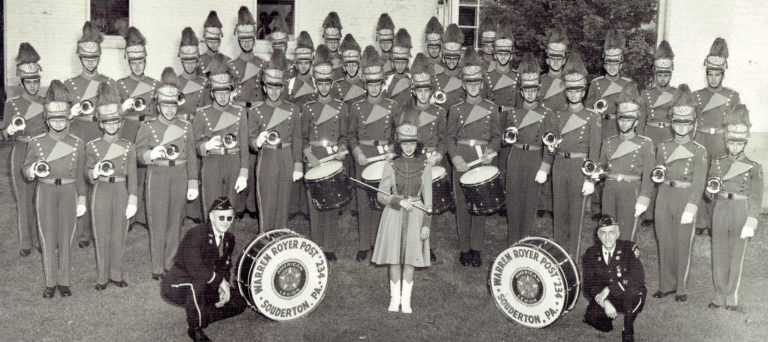
Members of the American Legion band pose in this photo from July 1950.
It was after a second world war, when more than 16 million Americans would serve in almost every corner of the globe, that the Veterans of Foreign Wars organized a local post in Telford.
The pool of veterans after World War II was certainly large enough to support two such organizations in the area, although VFW membership requirements are more specific in that eligible veterans are required to have “service in a war, campaign, or expedition on foreign soil or in hostile waters” as defined by Congress.
Despite that difference, VFW Post 5308 has a similar mission as Legion Post 234: leverage the power of millions of veterans on behalf of those who served and, in turn, to serve their communities. Interest was sufficient for the Independent to report on Dec. 27, 1945, that the VFW post would begin 1946 with 65 members and a goal of 100 by the first meeting of 1946 on Jan. 3.
Among the guest speakers at the investment of the post was Jesse Frederick, commander of the American Legion post in Souderton. He also represented the Telford Chamber of Commerce. Lloyd Frederick of Telford was installed as commander with most of the other officers also residents of Telford. They included Raymond Geisinger, Lamar Weigner, Claude Alderfer, William Savacool, Kermit Moyer, Lyman Kulp, Norman Frederick, William Schuler, Norman Kulp, Edward Moyer, and Paul Landis, according to the newspaper account.
After the ceremony, the public was invited to enjoy refreshments — the first of many times since that the doors were opened for the public to participate.
The post made its first home in a Quonset hut — a prefabricated, semi-circular building made from corrugated steel — below the baseball field on 4th Street in Telford. The present building at 4th and Broad streets in Telford was constructed in the 1960s.
The VFW post takes seriously its commitment to the community. It works with Keystone Opportunity Center, a social services agency in Souderton, to assist veterans in need and with veterans at the Coatesville VA Medical Center. The post supports Boy Scout Troop 14 as well as local fire, ambulance and diving services, and Souderton-area baseball.
Civic education is a large part of its activities. Post members place flags on graves at several area cemeteries for Memorial Day and perform a flag “retirement” ceremony on Veterans Day to respectfully dispose of used U.S. flags. It sponsors the Voice of Democracy speech contest for higher schoolers with a $30,000 scholarship as the prize.
And don’t forget bingo, breakfasts, wing nights and other activities where the public is welcome.
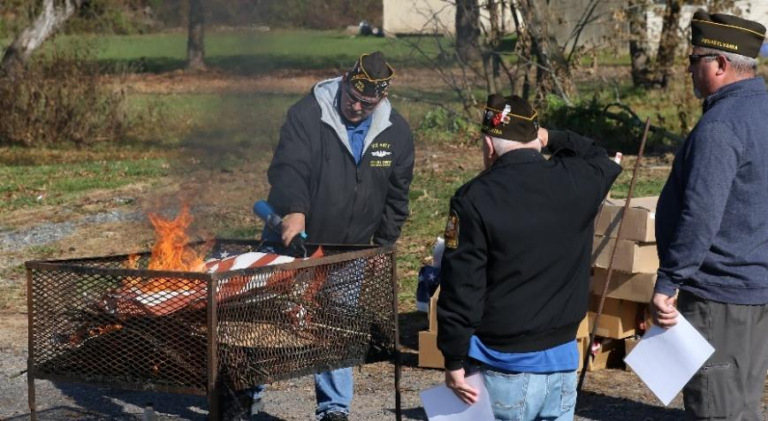
Members of the VFW at the 2023 flag retirement service.
Before we close out this look at the two veterans organizations in our towns, we need to talk about the weapons displayed on their respective properties. What’s their history?
The first thing to know is that the equipment is “demilitarized” — nonfunctional — and donated through a military program for display to:
- Serve as a tangible monument to the sacrifices of veterans and the wars in which they served. Posts often acquire equipment that is historically significant to their members.
- Raise awareness and attract members since the military hardware can spark conversations with the public.
- Reinforce the group’s connection to the armed forces and its mission to support veterans and military readiness.
The cannons outside the American Legion post are believed to be French made, while the naval equipment displayed at the VFW post comprises a gun mount, an anchor chain from the USS Sprig and a ship’s bell from the USS John Young — in 1994, one of the first combat ships to receive female crew members.
Which reminds us to add that both organizations accept female veterans who meet their eligibility requirements. So now you know!
Veterans in recent decades are often greeted with “thank you for your service.” As we learn from the history of our American Legion and Veterans of Foreign Wars posts, it becomes clear that the veteran’s service does not end with the homecoming. Care for each other and their community continues long after their service ends.

The Souderton-Telford Historical Society seeks to preserve and share the history of our towns, businesses, and residents. Follow us on Facebook (@SoudertonTelfordHistory) and enjoy posts about local history. Do you have old photographs we can scan for our collection? Or a story to share about growing up in the Souderton-Telford area? We would love to hear from you!
Email to newsletter@soudertontelfordhistory.org.
The Souderton-Telford Historical Society is a 501(c)(3) non-profit. Your contribution helps to collect, preserve, and share the history of our towns. Use the DONATE button on our Facebook page. Or mail tax-
deductible donations to:
Souderton-Telford Historical Society
127 E. Broad St.
Souderton, PA 18964
Have you visited the new website of the Souderton-Telford Historical Society? (soudertontelfordhistory.org) You can find our newsletter archive tagged and filed for easy reading. We thank pixelMIGHT for donating its services.
